We Document
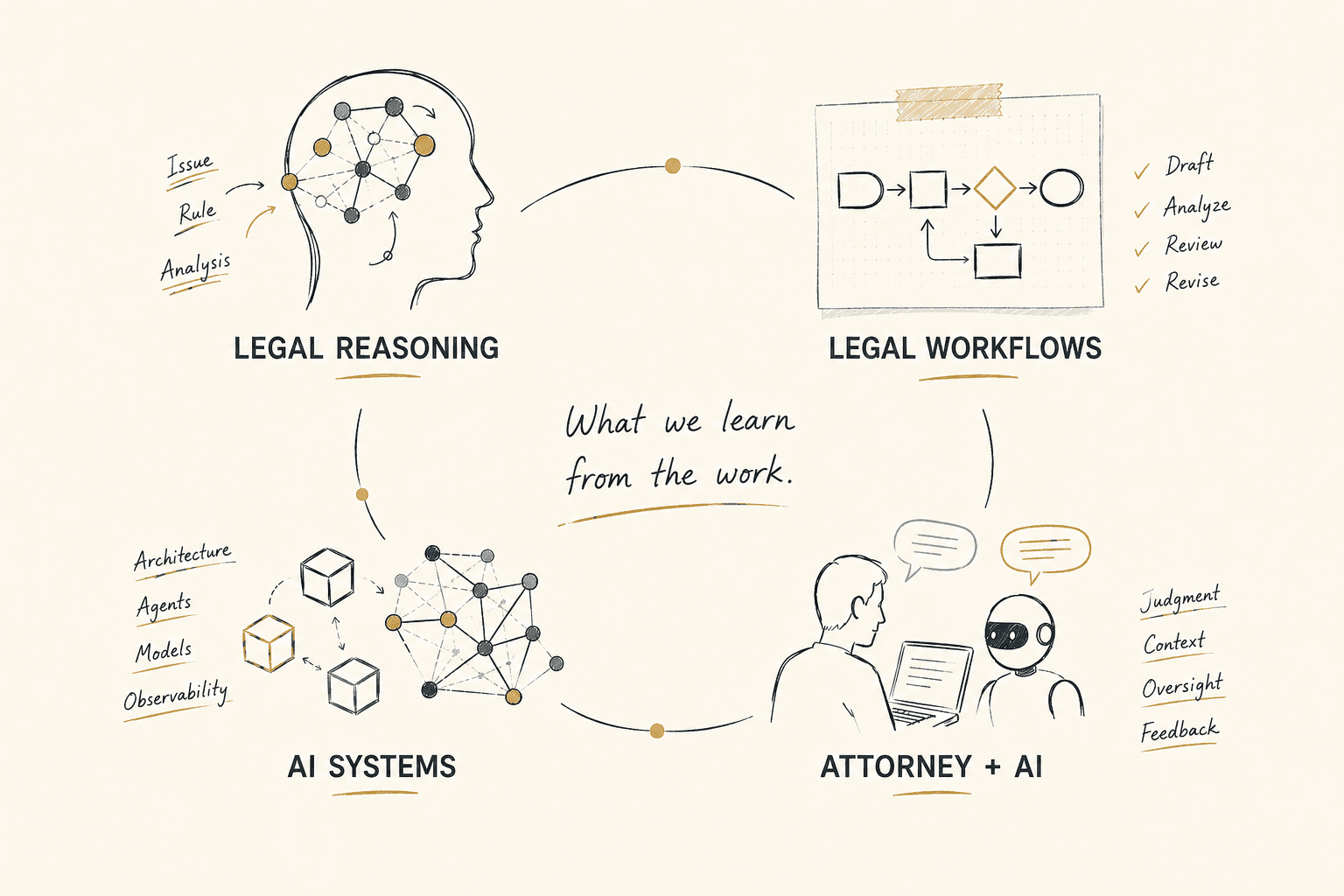
What we learn from the work.
Short notes from building and testing AI systems for legal work — what worked, what failed, and what we are still figuring out.
We Build → We Test → We Document → Tutorials
Legal AI Documenting
Observing · Recording · Learning · Sharing
01 · Categories
What do we document?
We document what we learn across four areas: legal reasoning, legal workflows, AI systems, and attorney + AI collaboration.
- 01
Legal Reasoning
How AI systems reason through legal problems — analysis, judgment, and where reasoning breaks down.
Explore notes - 02
Legal Workflows
How legal work is structured into workflows that AI systems can perform and attorneys can review.
Explore notes - 03
AI Systems
The systems themselves — architectures, models, multi-agent orchestration, and failure modes.
Explore notes - 04
Attorney + AI
Where attorney judgment enters the process, what it changes, and what AI systems need from it.
Explore notes
02 · Notes
AI Systems
Each note captures something specific we learned — what worked, what failed, or what we are still figuring out. These are practical observations from building and testing AI systems for legal work.
← All NotesAug 2026
Legal Reasoning · AI Systems
Why Legal Reasoning Cannot Be Reduced to One AI Prompt
Prompt engineering matters, but difficult legal work also requires engineering the context, loops, and structures around language models.
Read NoteAug 2026
Legal Workflows · AI Systems
Why Intermediate Work Products Matter in Legal AI
Intermediate work products make complex legal AI workflows visible enough to review and revise, and make the chain of legal reasoning easier to follow.
Read NoteAug 2026
AI Systems · Legal Workflows
Why an AI Legal System Needs More Than One Agent
A single model can answer a question. A legal system needs to manage a workflow with specialized AI agents.
Read Note