Legal Workflows · AI Systems
Why Intermediate Work Products Matter in Legal AI
Intermediate work products make complex legal AI workflows visible enough to review and revise, and make the chain of legal reasoning easier to follow.
The Problem
A legal AI workflow rarely produces its final work product in a single step.
One common mistake is to treat an AI system as a black box: put documents in, write a prompt, and expect an answer to come out. That may be convenient, but it is a poor way to approach complex legal work.
For a difficult legal task, the question is not only whether a final conclusion looks right. We also need to understand how the AI system got there. In particular, legal reasoning has something in common with engineering. A conclusion usually depends on a chain of intermediate steps: A supports B, B supports C, and C supports D. If one of those steps is wrong, the legal reasoning can collapse even if the final conclusion may sound convincing.
A system does not eliminate that chain. It can hide it.
That is why intermediate steps and their associated work products matter — they make the chain visible.
The Approach
We are treating intermediate outputs (i.e., artifacts) between stages as explicit work products rather than temporary information passed from one AI agent to another.
For example, a substantive legal task can be mapped into a workflow and decomposed into multiple stages, with each stage producing a different artifact:
- an intake record
- an initial analysis
- a substantive analysis
- a procedural compliance review
- a substantive compliance review
- a revision plan based on attorney feedback
- a revised analysis
- a final report
Each work product has a defined purpose and can be preserved as part of the workflow.
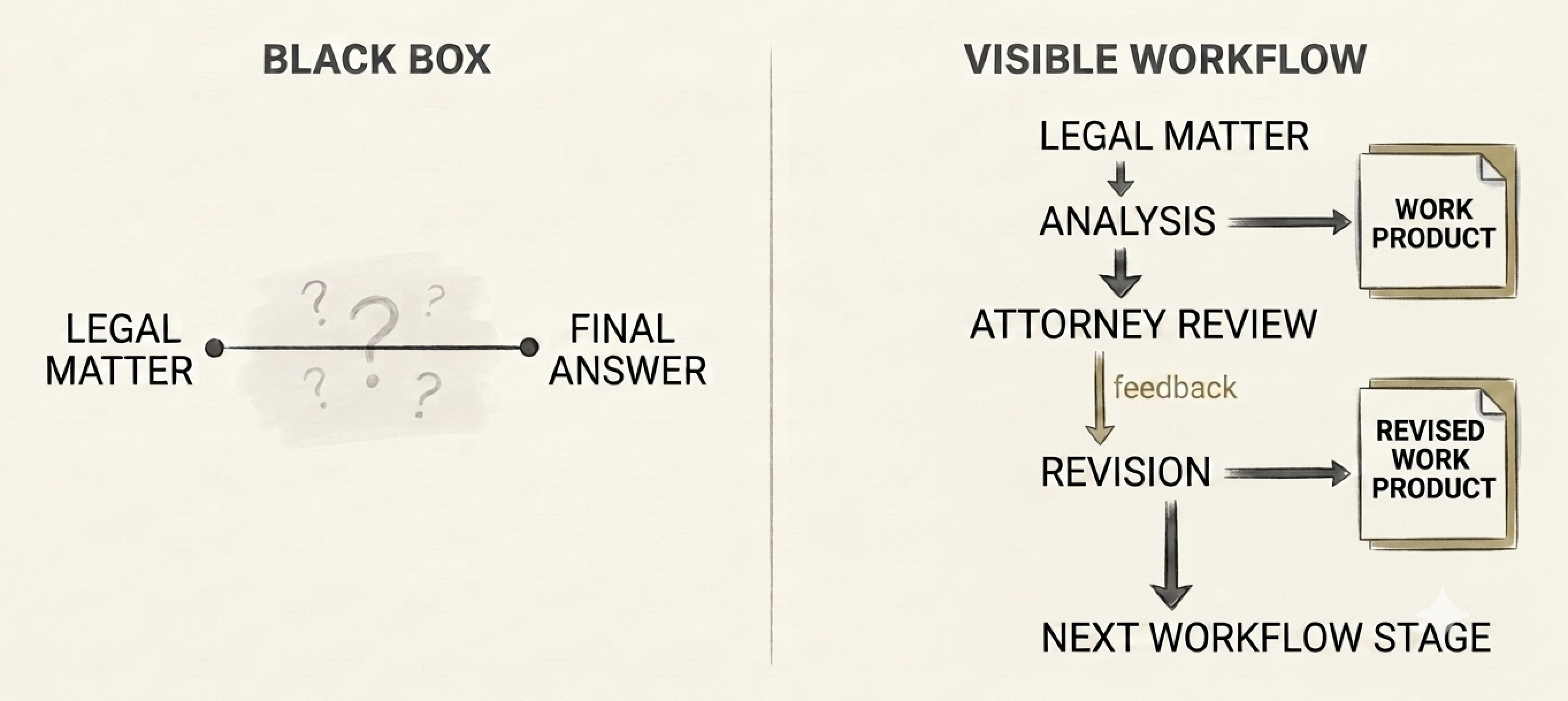
This creates an important distinction between two kinds of AI systems. In one, an AI agent produces an answer and passes it to the next AI agent, with much of the intermediate work disappearing into the system. In the other, meaningful stages of the work produce explicit artifacts that are saved and reviewed.
Apparently, the latter AI system is preferable, where artifacts can be versioned, reviewed, revised, and passed to subsequent stages.
Figure 1. Intermediate Work Products Make the Workflow Visible
What We Are Investigating
Our question is not simply whether intermediate work products produce better AI answers. We want to understand what becomes possible when the legal reasoning between the beginning and the final conclusion is made explicit.
For example:
- Which stages should produce a persistent work product?
- What information should each work product include?
- Which intermediate results are useful for attorney review?
- When should an intermediate work product be revised rather than replaced?
- How should later stages use earlier work products?
- Can intermediate work products help identify where an error entered the workflow?
- How much structure is useful before the workflow becomes unnecessarily complicated?
There is also a practical question. Not every artifact deserves to become a work product. Saving every intermediate response would create noise rather than useful information.
We expect the answer to depend on the type of legal work being performed.
Why It Matters
Making intermediate work product explicit creates places where an attorney can see what the AI system is doing.
An attorney does not have to inspect the entire workflow to review a particular analysis. A later stage can work from a defined work product rather than relying on an earlier AI agent's conversational context. And when something goes wrong, the AI system has a better chance of showing where the problem entered the workflow.
It also changes how attorney feedback can work. For example, instead of waiting until a final report is complete, an attorney can review an intermediate analysis, identify a problem, and send that feedback back to the stage where it matters. The AI system can then revise that work product before the workflow continues.
This makes intermediate work products more than records of what the AI system did. They become places where different parts of the AI system connect:
- one stage hands work to the next;
- one AI agent can build on another's work;
- an attorney can review and change the work;
- the AI system can preserve what happened along the way.
That visibility is difficult to get from a black-box interaction where the only thing that survives is the final conclusion.
Conclusion
Intermediate work products do not make a legal AI system reliable by themselves. Poorly designed work products can create unnecessary complexity, preserve incorrect conclusions, or allow errors to move from one stage to the next.
Their value is that they make the chain of legal reasoning visible.
A final work product may tell us what the AI system concluded, while intermediate work products can show us how it got there: where an attorney stepped in, what changed, and where something may have gone wrong.
For complex legal AI systems, that visibility may be just as important as the capability of underlying models.
That is what we are investigating: not simply whether AI can produce a useful final work product, but whether we can build AI systems where the work leading to that result is visible enough to inspect, review, and improve.